
TIMELINE
2026
ROLEProject Founder、Culture-Tech Curator&Digital Exhibition Lead Designer
SKILL
Cultural Research、Digital Heritage Interpretation、Cross-Sector Collaboration、Digital Exhibition Curation、Digital Storytelling、Display Technology Adaptation、East Asian Cultural Studies、Public Communication
—————————————————————————————————————————————————————————————————————————————————————————————————
The Bow Beyond Competition
INSPRIATION
I have trained and competed in competitive archery since 9th grade, and won the California regional championship at the 2026 USA Archery JOAD Indoor Nationals. At first, archery meant precision, focus, perseverance, and competitive results to me. But as I learned about Chinese ritual archery, Japanese kyūdō, and Korean traditional archery.
I began to ask a core question: why does the same practice carry layered meanings of ritual, education, self-cultivation, and cultural identity across different East Asian societies? Modern competitive archery prioritizes competition scores above all else — how did the cultural values embedded in traditional archery take shape, and how have they been transmitted to the present day?
ACTION
Grounded in my personal experience as a competitive archer, I will conduct a comparative study of traditional archery cultures across China, Japan, and Korea.Drawing on historical documents, cultural archives, and interviews with active athletes and academic researchers, I will analyze the connections between Chinese shèlǐ (Confucian ritual archery) and the Six Confucian Arts, the ritual tradition of Japanese kyūdō (the Way of the Bow), and the historical and cultural significance of Korean gungdo (traditional Korean archery). I will weave my firsthand experience in modern competitive archery into this cultural research, to examine how archery has served multiple social functions across different historical eras: military training, character education, ritual ceremony, and organized sport.
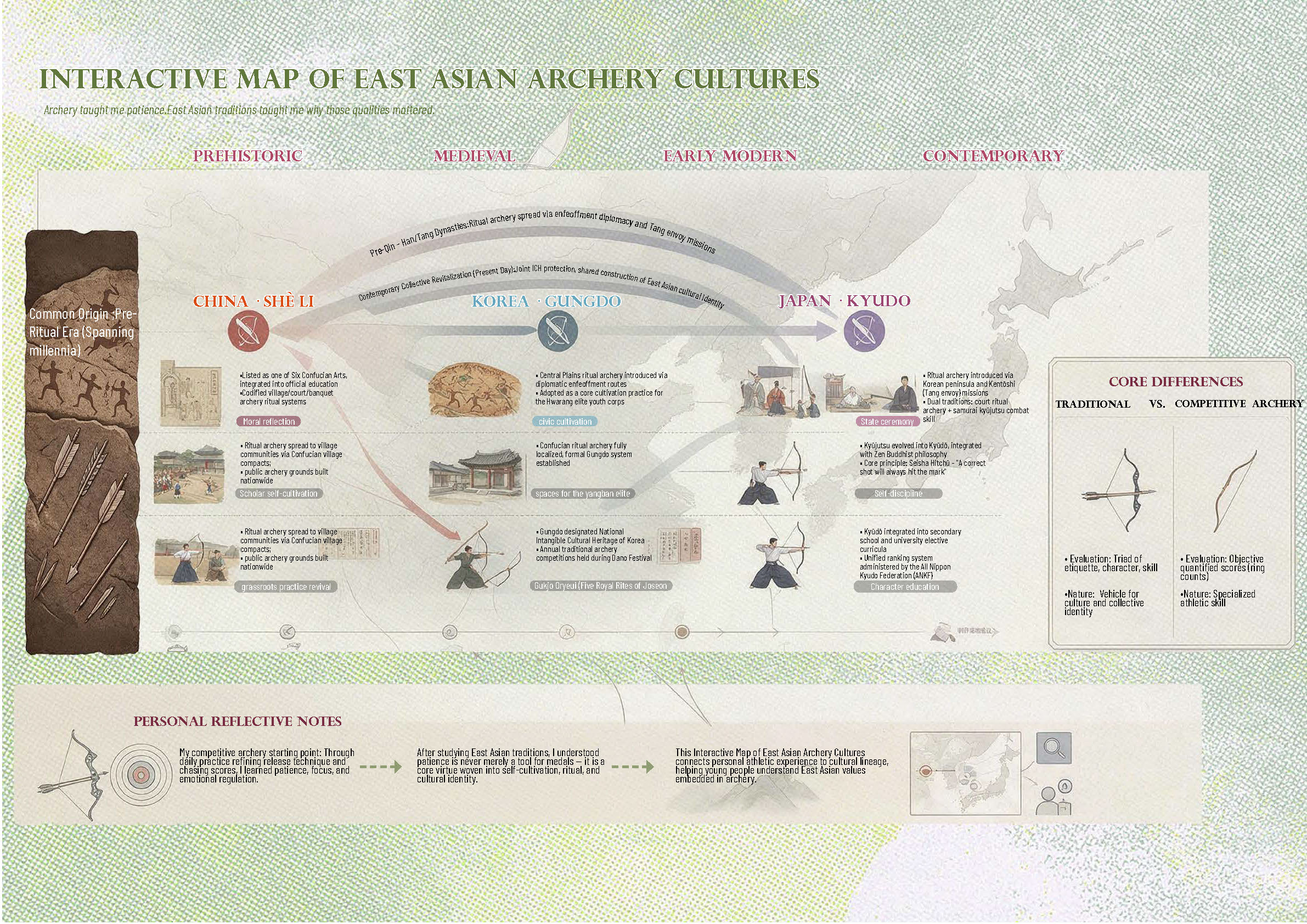
The map of East Asian Archery Cultures
Building on these research findings, I plan to create the Interactive Map of East Asian Archery Cultures. Through integrated historical timelines, cultural source materials, firsthand interviews, and personal reflective notes, the map will introduce more young people to the East Asian cultural traditions embedded behind archery practice.
IMPACT
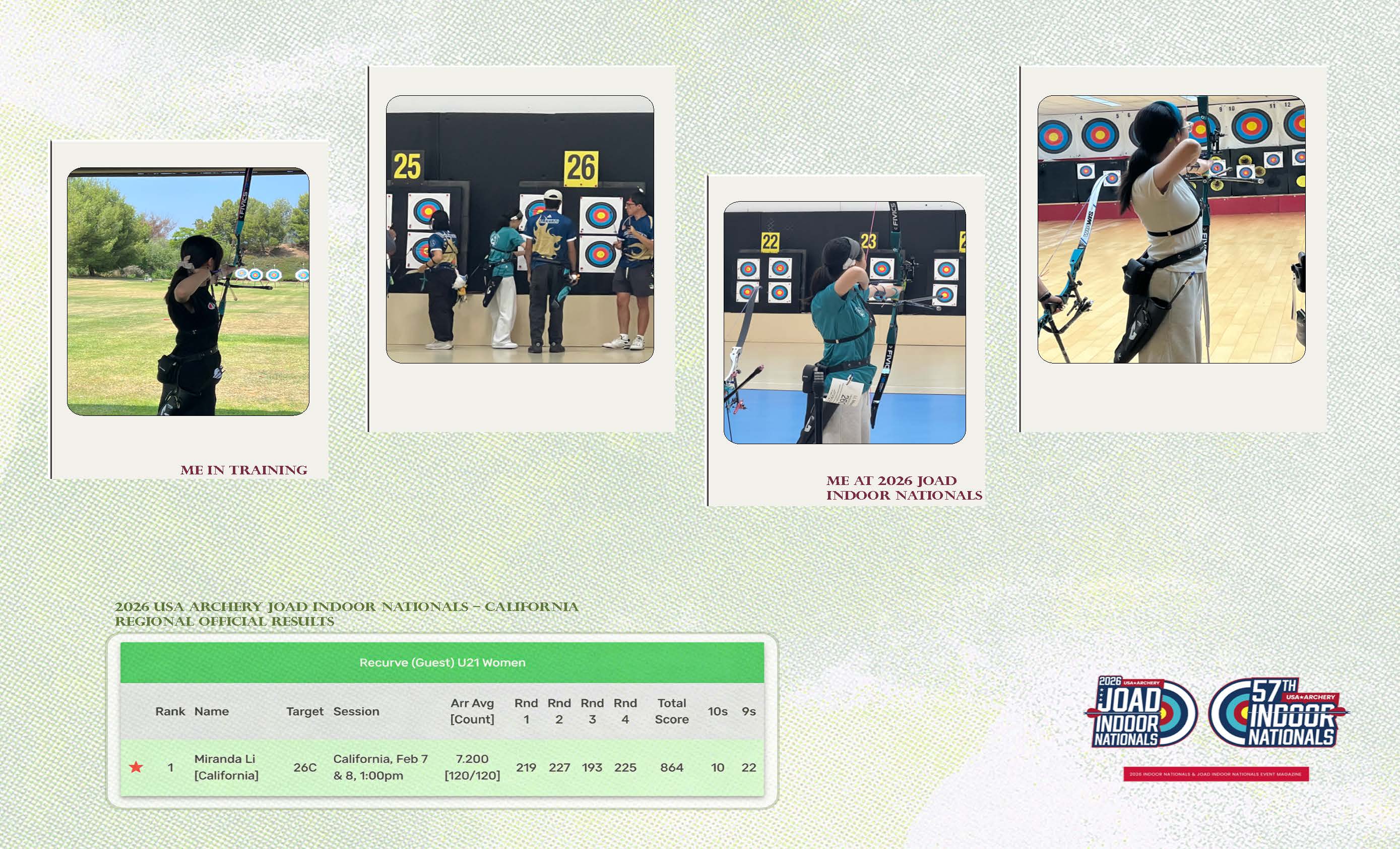
On the competitive front:
Years of consistent training and tournament participation culminated in my California regional title at the 2026 USA Archery JOAD Indoor Nationals, through which I built sustained, hands-on experience in elite youth competitive sport.
On the academic and cultural outreach front:
I plan to produce a full comparative research report on archery cultures across China, Japan and Korea, an organized archive of practitioner and researcher interviews, and the interactive digital cultural map. I will share these outputs through school presentations and public digital exhibitions. All planned future deliverables will be documented strictly based on completed work and verifiable data.
FUSION
My archery research has gradually led me to recognize that culture does not only exist in books, artworks, and historic buildings — it also lives in the rituals, repeated practices, and shared values that people enact in daily life.
This insight connects directly to my AP Drawing sustained investigation of "invisible rules" in Japanese public space: the archery project explores how culture is transmitted through formal traditional rituals, while the drawing project traces how unspoken social norms are embodied in everyday behavior. Meanwhile, my work on the Shanxi historic temple conservation project introduced me to the preservation of tangible cultural heritage, and traditional archery research has further deepened my understanding of living, intangible cultural heritage transmission.
Looking ahead, I aim to bring together history, philosophy, visual art, and digital technology to study how East Asian societies preserve cultural memory through ritual, space, art, and everyday practice — and to explore how these traditions persist, adapt, and evolve in modern society.